
Get Discounts with our Digital Tourist Discount Pass























Nyepi & Bali New Year 2026 – The Complete Guide
Everything Visitors Need to Know About Bali’s Day of Silence
Nyepi 2026 is Thursday, March 19. Bali shuts down completely for 24 hours from 6am March 19 to 6am March 20. The airport closes, roads are empty, tourists must stay in their accommodation. The evening before (March 18), Ogoh-Ogoh parades take place across the island — open to visitors and worth planning around.
Nyepi 2026 Dates
WED 18 Mar — Evening into the Night
Ogoh-Ogoh Parades across the island
Many shops will already close. ATMs may stop working — stock up on cash beforehand.
THU 19 Mar 6:00am — FRI 20 Mar 5:59am
Nyepi — Day of Silence. Total shutdown for 24 hours. Airport closed. Nobody goes outside.
FRI 20 Mar 6:00am
End of Silent Day. Most shops open again. Ngembak Geni celebrations begin across the island.
What you need to know about Nyepi and The New Year Celebrations in Bali
What is Nyepi and why is it important?
The Balinese New Year is not just a single day but a series of sacred rituals observed over six days. Nyepi, the Day of Silence, is the most well-known part, but it is only one aspect of this deeply spiritual celebration.
The Balinese New Year — A Six-Day Celebration
A time of purification, renewal, and reflection. The six-day observance includes:
- Melasti Ritual — A purification ceremony at the sea (3–4 days before Nyepi).
- Bhuta Yajna & Ogoh-Ogoh Parade — The night before Nyepi, featuring demon effigies and processions.
- Nyepi — The Day of Silence, where all activity in Bali stops.
- Ngembak Agni — The day after Nyepi, where families seek forgiveness and celebrate renewal.
When is Nyepi in 2026?
Nyepi — the Day of Silence begins on Thursday, March 19, 2026 at 6:00 AM and ends on Friday, March 20, 2026, at 6:00 AM. This is a 24-hour period of total silence observed across the entire island of Bali.
What happens during Nyepi?
During Nyepi, Bali completely shuts down for 24 hours.
- The airport is closed — no flights in or out.
- Shops, businesses, and restaurants are closed.
- No one is allowed outside, including tourists.
- Internet and mobile service may be restricted in some areas.
- Lights must be kept off or very dim.
Local security officers known as Pecalang enforce these rules throughout the island.
What happens if you break the Nyepi rules?
Nyepi rules are strictly enforced by local security (Pecalang). If someone violates the restrictions — making noise, using visible lights, or going outside — they will be asked to return indoors immediately. There are no formal legal penalties for tourists, but respect for this sacred tradition is expected and important.
Is Bali's airport open during Nyepi?
No. Ngurah Rai International Airport (DPS) is completely closed for 24 hours from 6:00 AM on March 19 to 6:00 AM on March 20, 2026. No flights can land or take off during this time. Plan your arrival and departure dates carefully — arriving the day before or departing the day after is the standard approach.
Are hotels open during Nyepi?
Yes, hotels remain open, but guests must stay inside the hotel premises for the full 24 hours. Most hotels offer special Nyepi packages with indoor activities, meals, and quiet programming. Outdoor lighting, pools, and entertainment are limited to respect the silence.
Can tourists leave their hotel during Nyepi?
No. Tourists must stay inside their accommodation for the full 24-hour period. All outdoor activities — visiting the beach, walking the streets, using vehicles — are prohibited. If you are staying in a private villa, the same rules apply. Stock up on food, water, and any essentials the day before.
What should I do if I am in Bali during Nyepi?
The evening before Nyepi (March 18), go and watch one of the Ogoh-Ogoh parades. They take place in Kuta, Seminyak, Ubud, Sanur, and most other areas — start around sunset and run until late.
On Nyepi day itself: stock up on food and essentials beforehand if you are staying in a villa or private accommodation. Stay indoors, keep lights dim, keep noise low. Many visitors use Nyepi for meditation, reading, and genuine rest — it is one of the most unusual and memorable nights you will have in Bali.
Make sure your visa dates work around the shutdown — if you need a B1 Tourist Visa (also known as Visa on Arrival), check that it covers your full stay including the Nyepi period.
What is the Ogoh-Ogoh Parade?
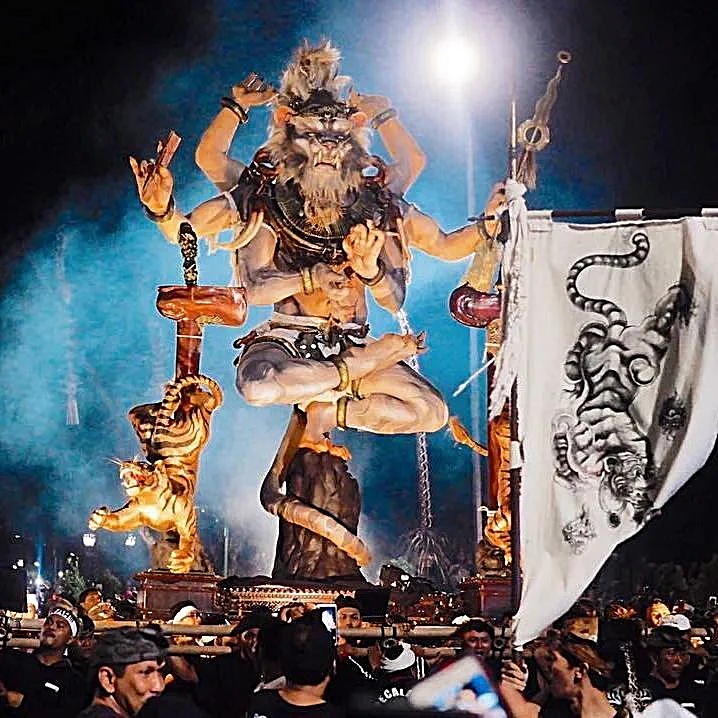
The night before Nyepi (March 18), Balinese villages hold the Ogoh-Ogoh Parade. Giant demonic effigies — some up to 8 metres tall, made from bamboo and papier-mâché — are carried through the streets accompanied by gamelan music, chanting, and noise-making to drive away evil spirits. After the parade, many Ogoh-Ogoh are burned to cleanse the island before the Day of Silence. The best locations: Kuta, Seminyak, Ubud, Nusa Dua, and Sanur.
What happens after Nyepi?
The day after Nyepi is called Ngembak Geni — “relighting the fire.” Families visit each other, ask for forgiveness, and celebrate renewal. Shops and restaurants reopen. In Denpasar, the famous Omed-Omedan Kissing Ritual takes place, where unmarried young people take part in a traditional mass-kissing ceremony. It is a day of socialising, noise, and life returning to the island.
When is Nyepi in the coming years?
Nyepi follows the Balinese Caka Calendar, based on the lunar cycle:
- Nyepi 2026: Thursday, March 19
- Nyepi 2027: Monday, March 8
- Nyepi 2028: Sunday, March 26
- Nyepi 2029: Thursday, March 15
- Nyepi 2030: Tuesday, March 5
Nyepi always falls on the day after the dark moon of the spring equinox.
Who is Batara Kala, and what is his connection to Nyepi?
Batara Kala is the Balinese god of destruction and time. He is believed to consume unlucky humans and is held responsible for solar and lunar eclipses. The Bhuta Yajna Ritual and Ogoh-Ogoh Parade are performed to appease Batara Kala and prevent misfortune in the new year — the noise, fire, and ceremony are all acts of spiritual protection for the island.
Nyepi — The Day of Silence, A Unique Tradition
Nyepi is a sacred Hindu holiday in Bali and an important public holiday across Indonesia. Unlike most New Year celebrations — marked by fireworks, crowds, and noise — the Balinese New Year reaches its peak in total silence. That contrast is what makes it one of the most striking experiences in Bali.
Why Nyepi Matters — The Balinese Calendar and the Caka Year
Nyepi marks the beginning of the Caka year, the Balinese New Year. On this day, the Balinese Hindu community dedicates 24 hours to prayer, fasting, and meditation — a reset for the individual and the island.
The Balinese calendar consists of 12 sasih (months), each lasting 35 days, aligned with the lunar cycle. Nyepi falls the day after the dark moon of the spring equinox, when day and night are nearly equal. According to local tradition, the island “hides” — embracing silence and darkness to deceive wandering evil spirits into believing Bali is uninhabited.
What Happens During Nyepi — The Three Days
The night before: Ogoh-Ogoh parades (March 18)
On the eve of Nyepi, Balinese men and boys carry towering Ogoh-Ogoh statues, some up to 8 metres tall. These intricately crafted figures, made from bamboo and paper, represent negative forces and evil spirits. The streets come alive with gamelan music, chanting, and deliberate noise-making to drive away dark energy before the silence begins.
Visitors are welcome to watch and photograph the parades. After the procession, many statues are ceremonially burned to purify the island. The most impressive parades take place in Kuta, Seminyak, Nusa Dua, Sanur, and Ubud. Each village competes to build the most striking Ogoh-Ogoh — the craftsmanship is extraordinary.
Nyepi day: complete silence (March 19, 6am to March 20, 6am)
From sunrise to sunrise, Bali enters a total shutdown. The airport closes. Roads are empty. Everyone — locals, expats, and tourists — stays indoors.
- Airport closed — no flights in or out for 24 hours.
- All transport halted — roads are patrolled by Pecalang security officers.
- Shops, restaurants, and beaches closed.
- No outdoor lighting — curtains must be closed, lights kept dim.
- Minimal noise.
The only exceptions are medical emergencies — hospitals remain operational. Pecalang officers patrol throughout the night.
If your trip falls around Nyepi, make sure your travel documents are in order well in advance. Police presence increases around this period, and holding a valid International Driving Permit is particularly important if you plan to ride a scooter or drive.
The day after: Ngembak Geni (March 20)
After 24 hours of silence, Bali returns to life with Ngembak Geni — the relighting of the fire. Families visit each other to exchange forgiveness and celebrate the new year. Shops and restaurants reopen. In Denpasar, the famous Omed-Omedan “Kissing Ceremony” takes place, along with street markets, community events, and cultural performances across the island.
Ngembak Geni is joyful, loud, and social — the release after 24 hours of stillness.
The Rituals of Nyepi — What Each Day Means
The Balinese New Year is not a single event. The full observance spans six days, each with its own ceremony and meaning.
Melasti Ritual — purification at the sea
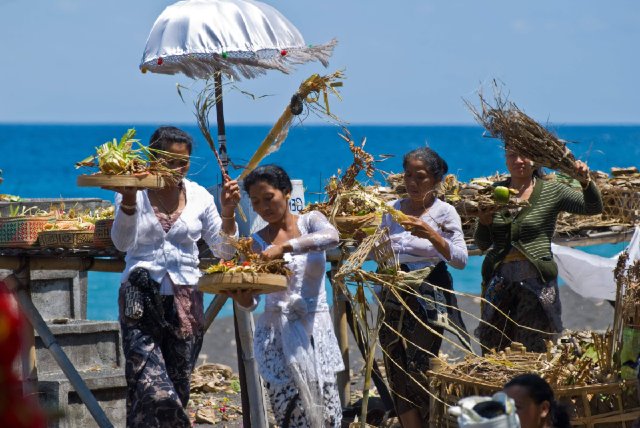
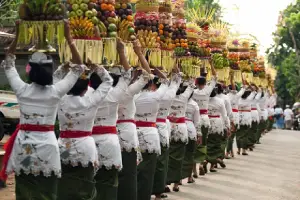
Three to four days before Nyepi, the Melasti Ritual (also known as Melis or Mekiis) takes place at seaside temples — Pura Segara. Dedicated to Sanghyang Widhi Wasa, the ritual collects holy water used to cleanse sacred temple objects including Arca, Pratima, and Pralingga. Processions of worshippers in white walk to the sea carrying temple objects — it is one of the most visually striking ceremonies in the Balinese calendar.
Bhuta Yajna Ritual & Ogoh-Ogoh Parade — banishing negative forces
The night before Nyepi, the Bhuta Yajna Ritual restores balance between God, humanity, and nature. Offerings known as Pecaruan are made to appease Batara Kala. During Tawur Kesanga and Caru ceremonies, villages construct giant Ogoh-Ogoh — the statues paraded at sunset with gamelan, drums, and noise to clear negative energy from the island.
Not all Ogoh-Ogoh are burned — some are kept by the village. Ask locals about their customs if you want to know what happens after the parade in a specific area.
The four prohibitions of Nyepi — Catur Brata Penyepian
On Nyepi itself, four sacred restrictions govern the entire island:
- Amati Geni — No fire or light, including electricity. No cooking or entertainment.
- Amati Karya — No work or physical activity, except spiritual practice.
- Amati Lelunganan — No travel or leaving one’s home.
- Amati Lelanguan — No entertainment or self-indulgence.
The Yoga Brata Ritual begins at 6:00 AM and runs for the full 24 hours. Many Balinese Hindus spend the day in meditation and prayer.
Ngembak Agni — the new year begins
The day after Nyepi, Ngembak Agni (also called Labuh Brata), marks the official start of the Balinese New Year. Families visit, forgiveness is exchanged, and relationships are renewed. Many people participate in Dharma Canthi — reading ancient scriptures including Sloka, Kekidung, and Kekawi. The Omed-Omedan Kissing Ritual in Denpasar is one of the most photographed traditions of this day.
When is Nyepi in Bali?
| Year | Date | Caka Year |
|---|---|---|
| Nyepi 2025 | Saturday, 29th March | 1947 |
| Nyepi 2026 | Thursday, 19th March | 1948 |
| Nyepi 2027 | Monday, 8th March | 1949 |
| Nyepi 2028 | Sunday, 26th March | 1950 |
| Nyepi 2029 | Thursday, 15th March | 1951 |
| Nyepi 2030 | Tuesday, 5th March | 1952 |